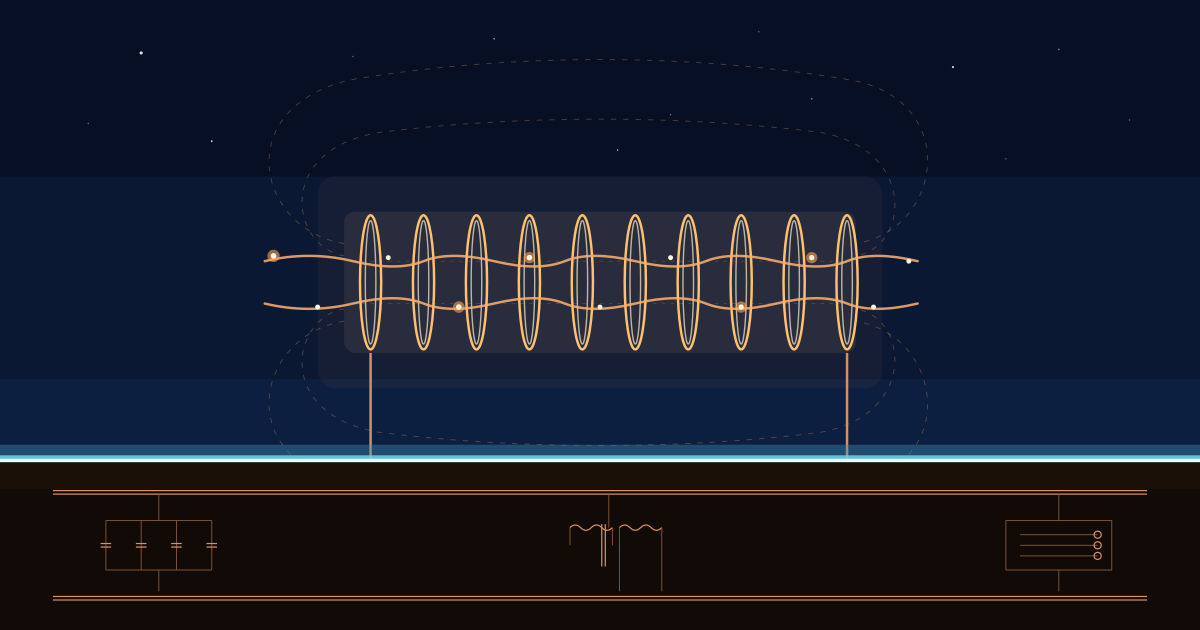
Category: dispatches

  • Direct Energy Conversion for Fusion: Fuel, Confinement, and the Cost Question

    Direct Energy Conversion for Fusion: Fuel, Confinement, and the Cost Question

    Every fusion power plant has to turn plasma energy into electricity. The default path is thermal: fusion power heats a working fluid that runs through a turbine to spin a generator. Turbines and generators convert heat to power in virtually every coal, gas, and fission plant on the grid. These are mature technology with known capital costs.

    The thermal conversion default has two drawbacks. Physics sets a low efficiency ceiling, and its hardware is expensive. Direct energy conversion (DEC) is used loosely here for any architecture that skips the heat cycle, the turbine, or both. Solar photovoltaics (PV) skip both, turning photons directly into current. Wind and hydro skip just the heat cycle, converting kinetic energy through a turbine to electricity. MHD generators skip just the turbine, extracting current from a conducting fluid in a magnetic field. Charged-particle DEC skips both, turning the kinetic energy of plasma particles directly into current by decelerating them against an electric potential, or by inducing current in surrounding coils as the plasma expands.

    Power flow in a 1 GWe p-B11 thermal-only mirror: 83% of fusion power (1,990 MW) is radiated as bremsstrahlung, 17% (448 MW) escapes as charged-particle transport, and both feed a single sCO2 turbine at 47%.

    The thermodynamic motivation for DEC is clear. Charged-particle DEC interacts directly with the plasma, whose temperature is 10⁸-10⁹ K, so the Carnot ceiling on efficiency η ≤ 1 − T_cold/T_hot is essentially 100%. The thermal default is bounded by what first-wall and blanket materials tolerate (500-700°C for RAFM steel and SiC composites), capping the Carnot limit around 60-65% against a 300 K cold sink. In practice, real thermal cycles lose another 10-15 percentage points to heat-exchanger and turbine irreversibilities, which is why sCO2 Brayton sits at 47% and combined cycle at 53%. Similar considerations inevitably reduce the efficiency of any DEC scheme as well.

    Different confinements need different capture hardware: venetian-blind grids for mirrors, inductive coils for pulsed concepts. This post walks through two charged-particle DEC paths, what each would need to deliver, and where the room to run actually is. The costing framework builds on our prior analysis of the industrial floor on fusion electricity cost (the LCOE remaining when the fusion core is treated as free); we reference it when free-core numbers appear, but this piece stands alone.

    Fusion Fuel and Direct Conversion

    Fusion DEC only works on charged particles. Neutrons carry no charge, and photons at keV bremsstrahlung energies have no demonstrated DEC path; TAE’s proposed X-ray capture scheme via cascading Auger emission (Binderbauer & Tajima, 2018) remains untested (see “p-B11’s Bremsstrahlung Constraint” below). DEC therefore favors fusion reactions that emit a small fraction of the energy in neutrons.

    Photon emission from a fusion plasma comes from plasma dynamics, not nuclear physics: electrons radiate bremsstrahlung as they scatter off ions. At fusion temperatures it becomes a debilitating loss channel. For p-B11, the high plasma temperature (>100 keV) and Z=5 boron drive intense bremsstrahlung: roughly 97% of fusion power in a thermonuclear plasma, leaving a 3% margin (Putvinski et al., 2019). Driving the plasma out of equilibrium widens the margin to about 17% (Ochs et al., 2022), but photons still carry 83% of the fusion power, and they hit the walls as heat. A thermal plant is the clear candidate to convert this heat to electricity.

    D-T puts 20% of its energy in 3.5 MeV alphas, a charged fraction that nominally exceeds p-B11’s 17% non-equilibrium margin. From the DEC standpoint D-T resembles p-B11: the bulk of the energy (80% in 14.1 MeV neutrons rather than bremsstrahlung) forces a full thermal plant, so DEC could at best be a small bottoming overlay on the alpha channel. D-T also carries the radioactivity burden p-B11 avoids: neutron activation of structural materials, lithium breeding blankets, and tritium inventory handling all raise plant cost without changing the DEC arithmetic. D-T is fundamentally a thermal fuel, and we do not consider it further here.

    D-He3 is the best DEC fuel by these criteria. The primary D-He3 reaction is aneutronic, but D-D side reactions produce neutrons and tritium. The output split depends on temperature, D/³He ratio, and confinement time. In a steady-state plasma at 50/50 mix and T = 70 keV, the bred tritium fuses with D and adds 14 MeV neutrons. A magneto-inertial plasmoid (Helion-style) holds the plasma too briefly for the secondary D-T reaction; the unburned tritium is exhausted, eliminating the 14 MeV neutron channel. The D/³He mix can then be chosen to minimize bremsstrahlung: D-rich (D/³He ratio of 3.2) at T = 100 keV is the Helion-likely operating point. The figure below contrasts the two cases; see the companion script for the Bosch-Hale + relativistic-bremsstrahlung calculation.

    Fractional split of fusion energy by output channel, by fuel and operating point.

    Two Paths to Fusion DEC

    Venetian Blind

    The venetian blind is the most mature DEC concept (TRL 4-5). It consists of angled metal ribbon grids at successively higher retarding potentials that sort ions by energy and collect them on high-potential electrodes. It mounts on linear magnetic confinement devices such as magnetic mirrors, as an add-on to the expander tank, collecting the particle stream leaving along field lines. It has no moving parts, and was demonstrated at 48% efficiency on real end-loss plasma at LLNL’s TMX (Barr & Moir, 1983), with a theoretical maximum of 70%. The 70% cap is set by grid geometry and the ion energy spread, not by the wall-material Carnot limit. Realta Fusion is the sole active developer, with a patented axisymmetric variant.

    Pulsed Inductive

    Pulsed inductive DEC is a less-mature DEC concept (TRL 3 for fusion use). It consists of coils surrounding a compression chamber that compress a pulsed plasma and then recover energy as it re-expands, inducing current via Faraday’s law, requiring no plasma-surface contact; the same coils drive both halves of the cycle. No published demonstration on fusion plasma yet. Helion Energy is the most prominent active developer, using D-He3 FRC plasmoids that collide and merge in the compression chamber. They claim 95% electrical round-trip efficiency on the capacitor → magnetic field → recovery-capacitor loop, measured on early machines without plasma present.

    Honorable Mention: MHD Generator

    A magnetohydrodynamic generator passes a conducting fluid through a transverse magnetic field, driving current through electrodes via the Lorentz force. No moving parts. From the 1960s through 1993, the US, Soviet, Japanese, and Australian governments spent hundreds of millions developing MHD generators on hot coal combustion gas, demonstrating up to 32 MW gross output at TRL 5-6. Liquid-metal MHD (LMMHD) has separately shown >71% efficiency at small scale; projected efficiency for LMMHD on fusion coolants is >60%.

    MHD is not a charged-particle DEC; it replaces the Brayton turbine, not the heat cycle, and is still Carnot-limited. Any fusion plant could route its coolant through an MHD channel instead of a turbine. For D-T, LMMHD integrated into the lithium breeding blanket handles neutron and thermal energy. For aneutronic fuels, it handles the bremsstrahlung fraction that charged-particle DEC cannot touch. The obstacle is that no fusion-MHD system has ever been built. The problem that killed the coal programs (electrode erosion from coal slag) doesn’t apply to clean fusion coolants, but a new one appears: MHD pressure drop, where liquid metal flowing through fusion-scale magnetic fields (5-15 T) experiences enormous drag, potentially consuming more pumping power than the MHD generates. This is an active research problem at ORNL and KIT Karlsruhe, with no demonstrated solution at reactor scale. For this analysis, MHD remains a what-if: promising physics, no costable design.

    p-B11’s Bremsstrahlung Constraint

    p-B11 is famous for its bremsstrahlung losses, and DEC can’t collect them. Even in the most favorable scenario, bremsstrahlung is 83% of fusion power and the charged-particle margin is only 17% (3% in thermonuclear operation). The thermal plant is not a small bottoming cycle in a p-B11 plant; it is the primary power conversion pathway, and DEC captures only the margin.

    The options for the radiated fraction are:

    1. Thermal cycle: a full turbine island converts bremsstrahlung heat at 47–53%. This is what the “hybrid” configurations modeled below assume. It works but preserves essentially the full thermal BOP.
    2. MHD on the coolant: if the bremsstrahlung-heated wall coolant is liquid metal, an MHD channel could convert at >60% with no turbine. Undemonstrated at reactor scale.
    3. Reject as waste: accept the efficiency loss and dump the bremsstrahlung heat to cooling towers. At 83% bremsstrahlung fraction, this means wasting most of the fusion energy. The overall plant efficiency collapses: a DEC at 85% efficiency on the 17% net charged fraction yields only 14% of fusion power as electricity, far worse than thermal-only (47%).
    4. X-ray photovoltaic DEC: convert bremsstrahlung directly to electricity via cascading Auger emission in nanometric high-Z/low-Z layers (Binderbauer & Tajima, 2018). If it works, this would capture the bremsstrahlung fraction without a thermal cycle, but no prototype has been built, no efficiency has been measured, and the radiation damage environment (keV photons at GW/m² flux for years) is extreme. This is a TRL 1 concept.

    Options 3 and 4 do not have a demonstrated path. Today, the thermal plant is the only demonstrated path for the radiated fraction. DEC, where it applies, captures only the charged-particle margin.

    Synchrotron is the other photon channel, and it does not impose a comparable constraint. The fundamental electron cyclotron frequency at 10 T is 280 GHz (1.2 × 10⁻³ eV), with harmonics extending into the THz band at fusion electron temperatures, six orders of magnitude below bremsstrahlung. Mm-wave synchrotron reflects at >99% from polished metallic first walls and is typically recycled into the plasma rather than captured; the few-percent escaping fraction could in principle feed a rectenna using mature GHz-band hardware, but the upside is bounded.

    Modeled Approaches

    We modeled two DEC architectures (venetian blind hybrid and pulsed inductive) with a free fusion core, using the same methodology as the previous dispatch. The “floor” is the LCOE that remains after zeroing out the fusion core: the irreducible balance-of-plant, buildings, O&M, and financing cost a fusion plant carries even if the heat source were free. Baseline conditions throughout this post are 1 GWe net, 85% availability, 7% WACC, 30-year life, and 6-year construction; aggressive conditions push these to 2 GWe, 95%, 3% WACC, 50 years, and 3 years. Numbers can be reproduced with the companion script.

    One caveat up front: the thermal capture hardware in the baseline (turbine island, generator, sCO2 Brayton loop) draws on a century of manufacturing cost-down, thousands of GW deployed, and well-understood NOAK pricing. The DEC estimates rest on much thinner ground: 1977 EPRI/LLNL studies for the venetian blind, and a single developer’s capacitor build-up for the pulsed inductive. Both sit closer to FOAK than the turbine they displace. The cost tables below compare them head-to-head today; the Learning Rates section returns to what DEC could look like once that gap closes.

    Venetian Blind + Thermal Hybrid (p-B11)

    We carry the p-B11 mirror baseline forward from the prior dispatch and add a venetian blind as an overlay. The thermal cycle is kept because 83% of p-B11 energy radiates as bremsstrahlung; the DEC captures only the charged particles leaving the mirror axially.

    Sizing the VB hardware to 400 MWe DEC output (2024 NOAK) lands at roughly $125M all-in, range $90-175M, comparable to the turbine island it partially replaces ($168M for sCO2 at 1 GWe). The breakdown:

    • High-voltage power conditioning: $45M, $100-120/kW, 60-70% of a MISO 2024 VSC HVDC station since the AC interconnect isn’t duplicated
    • Cryopumps: $15M, fusion procurement scale, scaled from the ITER torus and cryostat cryopumps (F4E delivered 8 units, EUR 21M F4E investment)
    • Thermal panels: $15M, hypervapotron-cooled tungsten panels for the 30-90 MW grid heat load, design analog to the ITER NBI residual ion dump and calorimeter (Hemsworth et al. 2017)
    • Grid and collector hardware: $15M, geometry from Hoffman 1977 escalated by CPI, cross-checked against the TMX integrated 48% demonstration (Barr & Moir 1983)
    • HV bushings, valves, controls: $12M
    • Vacuum tank: $7M, 304L stainless, 300-500 tonnes (10-15 m diameter, 20-40 m long, 10-15 mm wall + ring stiffeners). Same dimensional class as commercial refinery hydrocracker reactors (ExxonMobil Rotterdam, 4.5 m diameter, 25-30 m tall), where ASME Section VIII Div 2 vessels at 200 bar internal pressure run $26-30M; the VB tank only needs to hold vacuum (1 atm external collapse load), so it sits well below that price.
    • Plus 15% installation

    We model the hybrid with the DEC capturing 90% of the charged-particle transport. This is a geometric assumption that 10% of particles do not reach the venetian blind, e.g. lost radially.

    The venetian blind doesn’t lower the floor. With 83% of fusion energy radiated as bremsstrahlung, the DEC captures 90% of the 17% charged-particle margin. At the demonstrated 48% efficiency, the DEC hardware adds cost without meaningfully improving conversion. Even at 60% (never demonstrated on real plasma), the hybrid floor sits at $18/MWh, $1/MWh above thermal-only at $17/MWh, and adds about $25-30/kW on overnight capital. Eliminating the turbine entirely and wasting the bremsstrahlung is not viable for p-B11: without a thermal cycle, the plant needs 16 GW of fusion power for 1 GWe net, driving the fully costed LCOE far above the thermal path ($42/MWh).

    The numbers above use the mirror baseline heating power of 40 MW. If the heating power is larger, the picture shifts. The heating power leaves the plasma in the charged-particle transport channel, and is mostly captured by the VB. But at a heating wall-plug efficiency of 50% (the model’s NBI default) the injection chain draws 2 MW of gross electric per 1 MW delivered to the plasma, while the transport channel returns only 0.58 MW in the VB 60% hybrid. Each MW of heating therefore costs roughly 1.4 MW of gross electric output, and the fusion core upsizes to cover the shortfall. Holding net output at 1 GWe, LCOE rises by $2-6/MWh as heating goes from 150 to 400 MW; beyond 600 MW the recirculating fraction exceeds 50%. Thermal-only stays cheaper than the thermal+VB hybrid by about $0.9/MWh at every heating level: the VB hardware cost scales with DEC throughput alongside the recovery it provides, so the gap stays roughly flat across the sweep.

    Flipping the analysis: at fixed VB hardware cost, what efficiency would justify adding the DEC? At the 1 GWe p-B11 baseline the VB outputs roughly 232 MWe, from 90% capture of the 429 MW charged-particle margin at 60% conversion, and the model scales the VB hardware to about $85M at this plant scale. Holding that fixed, no VB efficiency between 30% and 100% breaks even with thermal-only; the VB hardware exceeds turbine-side savings across the entire physically accessible band. Break-even enters the physically accessible window only if the VB capex at this plant scale falls by roughly 3x, to around $30M, at which point a 54% VB suffices. The leverage is narrow: only 15% of fusion power flows through the DEC, so each percentage point of VB efficiency moves only 0.15 percentage points of plant-level conversion.

    Power flow in a 1 GWe p-B11 mirror with a venetian-blind DEC at 60% hybrid with a thermal cycle: 83% of fusion power (1,901 MW) radiates as bremsstrahlung and feeds the turbine, while the DEC captures only the 17% charged-particle margin (386 MW).

    Pulsed Inductive (D-He3)

    Pulsed inductive DEC using D-He3 FRC plasmoids is Helion’s concept; Polaris is currently under construction to test it on plasma. At the Helion-likely operating point (D-rich mix at T = 100 keV, no T burnup), 81% of the fusion energy is in charged particles that drive the inductive coils. Unlike the VB hybrid, no main turbine is retained and no thermal bottoming cycle is added; the pulsed-power chain is the only conversion stage, and the bremsstrahlung and neutron fractions are dumped to cooling as waste heat.

    With no turbine, the BOP becomes a pulsed-power chain: pulse-rated switchgear, capacitor or inductive storage to smooth the duty cycle, DC-DC converters to recharge the compression coils, and a grid-tie inverter at the back. Sizing the pulsed chain downstream of the driver to 1 GWe net (NOAK) lands at roughly $593M ($593/kW). The breakdown:

    • Recovery cap bank: $351M, sized to the fusion power balance (703 MJ at $0.50/J)
    • VSC HVDC valve hall + IGBT grid-tie: $150M, $150/kW net, set by industrial HVDC station pricing given pulse-rated topology and high-voltage interconnect
    • DC-DC links: $78M, $75/kW of gross output
    • Controls: $14M, 4% of the driver bank

    The compression bank itself ($351M) is accounted for as part of the driver (core).

    The BOP floor comes in $6/MWh above thermal: $24/MWh vs $18/MWh. The turbine island is not the dominant cost. Buildings ($354M), the electrical plant ($96M), O&M ($37M/yr), and financing charges together dwarf the turbine, and the pulsed-power chain that replaces it costs more than the turbine. Eliminating the turbine and its synchronous generator (including the GSU transformer and sync/protection gear) removes about $186M of overnight capital, but the $593M of pulsed-power hardware needed to shape, store, and grid-tie the recovered energy more than offsets those savings.

    The He-3 fuel cost is a different problem. At $2M/kg (optimistic), He-3 adds $36/MWh, roughly four times the 1-cent target by itself. At the DOE-allocated price of $4.5M/kg, it roughly doubles. Helion’s answer is to run a D-rich mix that maximizes D-D-bred He-3 and recover the He-3 between shots at assumed 99% efficiency; tritium from D-D is exhausted (or held until decay) rather than re-burned. If the fuel cost drops to zero, the D-He3 pulsed DEC floor sits at $24/MWh, still above thermal ($18/MWh) and well above the 1-cent target.

    Running the Helion-likely D-rich mix saves about $20/MWh of LCOE for pulsed inductive over the textbook 50/50 reference, almost entirely through reduced He-3 burn: more D-D side reactions produce more internal He-3 that the recovery loop re-injects, lowering external He-3 demand by about a quarter. Mix selection moves less than architecture choice (which moves $38/MWh between thermal and pulsed inductive), but it is a substantial lever at He-3 prices of $2M/kg.

    The plasma-present round-trip efficiency is the other open question. The theoretical framework (Kirtley et al., APS DPP 2024) suggests that 85% efficiency is a realistic target for Helion’s Diesel-cycle plan. At that level, the reduction of required fusion power by about a third and external He-3 burn by more than half is what carries the architecture, not the BOP hardware, which already costs more than a turbine.

    How much cheaper does the pulsed-power hardware need to be for Helion to compete on price? Assuming Helion’s stated goal of self-bred He-3 (fuel cost dropping to roughly zero), the Helion-likely LCOE falls from $81/MWh to about $57/MWh, in the upper range of gas and nuclear ($50-70/MWh). The pulsed-power chain at the modeled $593M contributes about $10/MWh of that. Making it free saves $10/MWh and brings Helion to $47/MWh. The floor below that is set by buildings, electrical plant, O&M, and financing, not the cap bank. Closing to p-B11 thermal ($42/MWh) requires squeezing those non-pulsed-power line items as well; closing to the 1-cent target is out of reach by hardware learning alone.

    Power flow in a 1 GWe D-He3 plant at the Helion-likely operating point (D-rich mix, T = 100 keV, T exhausted, 99% inter-shot He-3 recovery, no thermal bottoming): 1,348 MW of charged-particle transport drives the pulsed inductive DEC at 85%; bremsstrahlung (276 MW), neutrons (39 MW), and DEC waste are dumped to cooling. p_fus = 1,695 MW. The textbook 50/50 reference (24% brem, 6% neutrons) appears as the D-He3 column in the energy-channel figure above.

    The Floor Is Industrial, Not Architectural

    Pushing every parameter to aggressive limits (2 GWe, 95% availability, 3% WACC, 50-year life, 3-year construction) collapses the gap between thermal and DEC, for both fuels:

    For p-B11, hybrid DEC and thermal land within $0.2/MWh: the DEC overlay costs about as much as the thermal hardware it partially replaces. (Pulsed inductive is not viable for p-B11: wasting 83% of fusion energy as bremsstrahlung without a thermal cycle requires an enormous core that more than offsets the turbine savings.) For D-He3, He-3 fuel at $2M/kg dominates everything else; self-breeding closes that gap and pulsed inductive then ends up $6/MWh higher than thermal because the pulsed-power chain is more expensive than the turbine.

    The floor is set by the industrial cost of building, staffing, and financing a large power plant, not by the power conversion choice. DEC’s value, if any, has to show up on the costed core or the fuel bill.

    DEC has a separate role that does not appear in the floor analysis: enabling breakeven. Where the recovery stage is intrinsic to the cycle (Helion-style pulsed inductive, with no thermal-only fallback), DEC efficiency is the gating condition for net electric output, not a cost knob. A plant below some round-trip threshold produces no net electricity at all; above it, the plant works but operates at high recirculation by construction, and LCOE tracks the small net output rather than the large gross. Enabling and economic are different bars; clearing the first does not clear the second.

    Where DEC Pays Off

    The floor represents the LCOE of a fusion plant with a free fusion core. Since the core is not free, DEC’s value emerges through two mechanisms: (1) higher conversion efficiency reduces the fusion power required for a given net electric output, lowering the costed-core capital; and (2) for expensive fuels, lower fusion power also reduces the fuel cost. The two fuels respond very differently to these mechanisms.

    D-He3: a fuel lever

    In the fully costed D-He3 plant at 1 GWe baseline conditions:

    For the venetian blind, the core cost rises modestly ($22M): the added DEC hardware partially offsets the savings from a smaller heating system. For pulsed inductive, the core jumps about $380M because the pulsed-power chain that replaces the turbine (dominated by the recovery cap bank) is substantial. LCOE drops $10/MWh with the venetian blind and $38/MWh with pulsed inductive, but the pulsed savings come mostly from fuel: higher efficiency, the D-rich operating mix, and active He-3 recovery between shots all reduce external He-3 demand. For D-He3, DEC is primarily a fuel-saving technology.

    p-B11: no fuel lever

    For p-B11 (negligible fuel cost), the second channel disappears, and only the core-shrinkage channel remains. Because bremsstrahlung dominates the fusion energy split, even an efficient DEC captures only the 17% charged-particle margin and does not meaningfully reduce the required fusion power. Thermal LCOE is $42/MWh; VB DEC 60% is $42/MWh (core $1,553M vs $1,585M). The DEC overlay neither lowers the floor nor shrinks the core enough to pay for itself.

    Learning Rates

    The numbers above are snapshots. Deployed technologies get cheaper. Turbines have been manufactured for over a century with thousands of GW deployed; there is little room for costs to fall. The DEC concepts are much lower TRL, with larger cost uncertainties but more room for learning.

    The venetian blind is the most mature DEC. Its dominant costs (vacuum vessels, cryopumps) are mature industrial hardware, 75% of total cost. The grids are 2%. Little room to learn down.

    The pulsed inductive path is different. Capacitor banks and power electronics dominate, and both are early in their deployment curves. The NOAK assumption in the 1costingfe model is $0.50/J stored (all-in: capacitors, switches, charging, buswork). Today’s lab pricing is $20–50/J, a 40–100x gap, comparable to what solar PV achieved over two decades. Grid-tie inverters have already followed that curve ($1,000/kW in the early 2000s to $100–150/kW today). But the fusion-specific components (capacitors rated for 100 million cycles at high energy density) do not yet exist as commercial products. The $0.50/J figure is a target, not a price anyone can buy today.

    The pulsed floors in this post already assume the 40–100x reduction has happened. If capacitors stay at $5–20/J, those floors rise substantially and the economics favor a turbine. Capacitor lifetime compounds the risk: the model assumes 10⁸ shots (NOAK), but current high-energy-density capacitors achieve roughly 10⁷ cycles, which at a 1 Hz rep rate is four months of operation between bank replacements. The thermal and venetian blind floors carry no comparable risk.

    Efficiency and capital cost ranges for the four conversion architectures. MHD is dashed because no fusion-relevant cost basis exists; pulsed inductive assumes the $0.50/J NOAK capacitor target.

    Conclusions

    1. DEC’s potential value is efficiency, not BOP savings. No DEC has demonstrated efficiency above 48% on real plasma, comparable to sCO2 Brayton. If higher efficiencies are achieved, the payoff is a smaller fusion core for the same net output. This shows up in the fully costed plant, not the free-core floor.

    2. Enabling and economic are different bars. DEC’s value can be cost-reducing or breakeven-enabling. Pulsed inductive concepts have no thermal-only fallback, so DEC efficiency gates whether the plant produces net electricity at all. But an enabling-only plant operates at high recirculation by construction, and LCOE reflects the small net rather than the large gross; clearing breakeven does not clear economics.

    3. Power electronics ride a learning curve; turbines don’t. Turbines have had a century of optimization and sit near their asymptote. Capacitors, pulse-rated switchgear, and grid-tie conversion sit on the same semiconductor and manufacturing-volume curves that took solar PV and inverters from lab to commodity. Capacitor pricing has roughly 40-100x to fall to hit the NOAK target used here, a reduction comparable in magnitude to what PV achieved over two decades. DEC’s cost model has two levers that move in the right direction, efficiency and unit cost; the thermal path has neither.

    4. The venetian blind has headroom. At the demonstrated 48% efficiency, the DEC hardware costs about as much as the turbine it replaces, with comparable conversion. The theoretical ceiling is 70%, with commercial efforts to close the gap underway at companies like Realta. A sustained >60% efficiency on real plasma is the concrete milestone that would flip the venetian blind from even trade to clear win.

    5. Pulsed inductive hinges on unverified efficiency; Polaris will measure it. If the round-trip efficiency is 85%+, the pulsed architecture cuts the required fusion power by about a third and external He-3 demand by more than half (combining higher conversion efficiency, the D-rich operating mix, and inter-shot He-3 recovery). The pulsed-power chain that replaces the turbine costs more than a turbine, so BOP is more expensive than thermal; the savings come from fuel and core size, not conversion hardware. If efficiency is below 70%, the fuel savings shrink and the higher BOP cost favors building a turbine. The gap between viable and not sits in roughly 15 percentage points of unverified efficiency, which Polaris is expected to measure on plasma.

    6. MHD generators could close the gap, someday. An MHD generator on the bremsstrahlung-heated coolant could convert the radiated fraction at >60% with no moving parts. The physics is demonstrated; the engineering for fusion environments is not, with liquid-metal MHD pressure drop at fusion field strengths the outstanding problem.

    7. D-He3 is the better DEC fuel, if you can get the He-3. D-He3 has manageable bremsstrahlung (16-24% of fusion power) and a large charged fraction, making DEC a significant power path rather than a margin add-on. But purchased He-3 costs $36-74/MWh depending on architecture, far more than the entire BOP floor. Self-breeding eliminates this, but whether a D-He3 device can breed enough He-3 to sustain itself is undemonstrated.

    8. The p-B11 floor is industrial, not conversion-limited. At baseline conditions, the p-B11 cost floor is $18/MWh, and a venetian blind DEC overlay raises it slightly rather than lowering it. With 83% of fusion energy radiated as bremsstrahlung, the thermal plant handles the majority of conversion and cannot be eliminated without an enormous increase in fusion power. At aggressive conditions, thermal and hybrid DEC converge to $7.6-7.9/MWh. The floor is dominated by buildings, electrical systems, O&M, and financing, so DEC’s leverage, if any, has to come from elsewhere.

    The path to 1-cent fusion energy does not run through direct energy conversion alone. DEC does not remove the industrial cost structure that creates the floor, and reaching $10/MWh still requires the conditions identified in the previous dispatch: large plants, high availability, low-cost financing, fast construction, and long plant life. But DEC has room to run in ways the thermal path does not. Three tractable development targets would turn that room into numbers: venetian blind efficiency sustained >60% on real plasma, Helion’s round-trip demonstrated at 85%+ on Polaris, and MHD pressure drop solved at fusion field strengths. Each is an experimental program, not a research miracle.

    Acknowledgements

    Thanks to Ian Ochs, Elijah Kolmes, and Ryan Weed for their comments.

    References

    1. Moir, R.W. & Barr, W.L., “Venetian-blind direct energy converter for fusion reactors,” Nuclear Fusion 13, 35–45 (1973). Link
    2. Hoffman, M.A., “Electrostatic Direct Energy Converter Performance and Cost Scaling Laws,” UCID-17560, LLNL (1977). Link
    3. Slough, J. et al., “Creation of a high-temperature plasma through merging and compression of supersonic field reversed configuration plasmoids,” Nuclear Fusion 51(5), 053008 (2011). Link
    4. Putvinski, S.V., Ryutov, D.D. & Yushmanov, P.N., “Fusion reactivity of the p-B11 plasma revisited,” Nuclear Fusion 59(7), 076018 (2019). Link
    5. Ochs, I.E. et al., “Improving the feasibility of economical proton-boron-11 fusion via alpha channeling with a hybrid fast and thermal proton scheme,” Physical Review E 106, 055215 (2022). Link
    6. Kirtley, D. et al., “Generalized burn cycle efficiency framework,” APS DPP 2024, Abstract GO05.8. Presentation
    7. CATF IWG, “Extension of the Fusion Power Plant Costing Standard,” arXiv:2602.19389 (2026). Link
    8. Rosa, R.J., Magnetohydrodynamic Energy Conversion, Hemisphere Publishing (1987). Link
    9. GAO, “Magnetohydrodynamics: A Promising Technology for Efficiently Generating Electricity From Coal,” EMD-80-14 (1980). Link
    10. Shea, D.A. & Morgan, D., “The Helium-3 Shortage: Supply, Demand, and Options for Congress,” Congressional Research Service, R41419 (2010). Link
    11. Barr, W.L. & Moir, R.W., “Test Results on Plasma Direct Converters,” Fusion Technology 3(1), 98-111 (1983). Link
    12. Fabris, G. & Hantman, R.G., “Interaction of fluid dynamics phenomena and generator efficiency in two-phase liquid-metal gas magnetohydrodynamic power generators,” Energy Conversion and Management 21(1), 49-60 (1981). Link
    13. Pinkhasov, D. et al., “CDIF 32-MWt MHD Program Results,” Proc. 31st Symposium on Engineering Aspects of MHD (1993). Link
    14. Smolentsev, S. et al., “MHD Thermofluid Issues of Liquid-Metal Blankets: Phenomena and Advances,” Energies 14(20), 6640 (2021). Link
    15. Binderbauer, M.W. & Tajima, T., US Patent 9,893,226 B2, “Photon-to-electric direct conversion” (2018). Link
    16. Ramasamy, V. et al., “Documenting 15 Years of Reductions in U.S. Solar Photovoltaic System Costs,” NREL/TP-7A40-92536 (2025). Link
    17. Realta Fusion, US Patent 12,166,398 B2, “Axisymmetric ferromagnetic venetian blinds” (2025). Link
    18. 1cFE, “1costingfe: Open-source fusion techno-economic model.” GitHub

  • Fusion’s cost floor: what if the core were free?

    Fusion’s cost floor: what if the core were free?

    If the deuterium-tritium fusion core were free (magnets, blankets, heating systems, handed to you at zero cost) the plant would still produce electricity at around $29/MWh. That is nearly three times the 1-cent per kWh target we are interrogating. The cost uncertainty is not in the turbines or the buildings. It is in the fusion core. And the range of estimates for that core is large. This dispatch will examine the theoretical cost-of-electricity floor in a power plant where the fusion core, the largest unknown, is ignored.

    Published estimates for a commercial fusion plant range from $47/MWh for an optimistic nth-of-a-kind advanced tokamak (ARIES-AT, Najmabadi et al., 2006) to $160+/MWh for a first-generation EU-DEMO (Entler et al., 2018), with most serious estimates landing between $50 and $130/MWh (Sheffield & Milora, 2016). Recent analysis from Cambridge suggests early fusion plants will exceed $150/MWh even with production learning (Lindley et al., 2023).

    Cost estimates for commercial fusion projects are largely kept under wraps. Experts disagree on the eventual costs. A recent Nature Energy analysis compiled first-of-a-kind CAPEX estimates from a range of experts and the literature and found a range of $1,400 to $43,000 per kilowatt, a 30x spread (Tang et al., 2026).

    We are seeking corridors for fusion to have a revolutionary price point: 1 cent per kilowatt-hour. If we start by accounting for the components we’re certain about and that exist today at commercial scale, we establish the lower bound on what fusion electricity can cost.

    The question we ask: what does the plant cost if the fusion core were free?

    Components of a fusion plant with thermal power conversion

    Thermal Conversion: The Heat Engine

    A fusion plant must convert the energy generated in the fusion core to useful electricity. For this purpose, most projects envision using a heat engine (turbines, generators, cooling towers) in addition to a switchgear, a control room, and a building to put it all in. These components are mature industrial hardware, with no real price uncertainty or learning rates. Beyond the equipment itself, a plant incurs indirect costs (engineering, project management), owner’s costs (staff recruitment and training), supplementary costs (shipping, spares, insurance, decommissioning provisions), financing charges, and ongoing operations and maintenance. All of these are well-characterized from existing power plant experience.

    Using the 1costingfe techno-economic model, we can approximate costs for these components in a 1 GWe plant. The table below uses a supercritical CO2 Brayton cycle, which gives the lowest floor of the three options we modeled (Rankine, sCO2, and combined cycle). All numbers in this post can be reproduced with the companion script.

    The table shows a D-T plant where all electric power goes through the thermal cycle. For aneutronic fuels (D-He3, p-B11), bremsstrahlung radiation carries most of the fusion energy to the walls as heat, so the thermal cycle remains the primary power conversion pathway even with direct energy conversion. The turbine cost drops modestly to $168M and the BOP subtotal to $374M:

    ComponentCostWhat it is
    Turbine & generator$180MsCO2 turbomachinery, comparable to gas plant hardware
    Electrical plant$98MSwitchgear, transformers, grid connection
    Miscellaneous equipment$60MCranes, compressed air, fire protection
    Heat rejection$55MCooling towers and circulating water
    BOP subtotal$390M

    The BOP equipment is priced from NETL’s Cost and Performance Baseline for Fossil Energy Plants (DOE/NETL-2022/3575) and the ARIES cost account documentation (Waganer, UCSD-CER-13-01, 2013), adjusted to 2024 dollars.

    The Rest of the Plant

    Buildings are not fuel-independent. A fusion plant includes roughly 18 distinct buildings and site structures: reactor building, turbine hall, heat exchanger building, cryogenics facility, power supply building, control room, maintenance shops, and others. About half of these (turbine hall, cryogenics, switchgear, assembly hall) are the same regardless of fuel. The other half (reactor building, hot cell, ventilation systems, fuel storage, site improvements) vary with the radiation and tritium hazards of the fuel. A D-T plant needs biological shielding walls in the reactor building, a hot cell for remote handling of activated components ($90M by itself), tritium containment barriers, and nuclear-rated HVAC with HEPA filtration. An aneutronic p-B11 plant needs none of these: the reactor building is a standard heavy industrial crane hall, there is no hot cell, and the HVAC is conventional. The result is a range from $354M (p-B11, industrial-grade) to $570M (D-T, enhanced-industrial). We return to the fuel-specific breakdown below.

    On top of the direct costs, there are indirect costs (engineering, project management, roughly 20% of directs), owner’s costs, supplementary costs (shipping, spares, insurance, decommissioning provisions), and financing charges. For a 1 GWe D-T plant with a free fusion core, these add up: $570M buildings + $390M BOP equipment + $195M indirects + $39M owner’s costs + $220M supplementary costs = $1,414M overnight, plus $280M interest during construction, for a total capital cost of $1,700M. A plant also needs staff, roughly 30 to 80 full-time employees at 1 GWe scale depending on fuel choice and the associated radiation protection requirements, costing $18-40M/year in loaded operations and maintenance (O&M). The LCOE is the annualized capital charge plus O&M, spread over the plant’s lifetime energy production. All of these costs are included in the LCOE floors reported below.

    Quantifying the Deuterium-Tritium Cost Floor

    Deuterium-tritium (D-T) is the mainstream fuel choice for fusion. It produces 80% of its energy as 14.1 MeV neutrons, which activate structural components and require heavy shielding, and it uses radioactive tritium, an environmental hazard if it leaks into groundwater. Even with a free fusion core, a D-T plant still needs buildings with radiation shielding, tritium containment with secondary barriers, hot cells for remote handling of activated components, and nuclear-rated HVAC. These requirements are driven by the hazards themselves (neutron activation and tritium inventory), not by regulatory classification. The buildings cost $570M at 1 GWe, and the plant requires roughly 80 staff for radiation protection, tritium handling, and the maintenance procedures these hazards demand.

    For a 1 GWe D-T tokamak at standard financial assumptions (7% weighted average cost of capital (WACC), 85% availability, 30-year life, 6-year construction), the Levelized Cost of Electricity (LCOE) floor with a free fusion core is $29/MWh, nearly three times the 1-cent target ($10/MWh). The overnight capital cost of this core-free plant is $1,720/kW.

    For context, the fully costed D-T tokamak at the same conditions comes in at $83/MWh. The fusion core accounts for about two-thirds of that. But the remaining third ($29/MWh of buildings, BOP, staffing, and financing) already exceeds the 1-cent target by itself. No improvement in the fusion core can close a gap that lives outside the core.

    Lowering the D-T Floor

    The $29/MWh floor assumes a single 1 GWe plant built with commercial project finance. Can we push it down to $10/MWh by improving the parameters that are independent of the fusion core? The parameters are:

    • Scale spreads fixed costs (buildings, staff, indirects) over more megawatt-hours
    • Availability produces more energy per dollar of installed capital
    • Financing cost (WACC) determines the annual capital charge rate
    • Construction time determines interest during construction
    • Plant lifetime determines how many years of revenue amortize the capital
    • Staffing determines O&M cost, which can be half the floor at large scale
    Scenario (D-T)Floor ($/MWh)Overnight ($/kW)Budget left for core
    Baseline: 1 GWe, 85%, 7% WACC, 30yr, 6yr build291,720-$19/MWh
    2 GWe, 85%, 7%, 30yr, 6yr241,500-$14/MWh
    2 GWe, 95%, 3%, 50yr, 3yr build141,210-$3.7/MWh
    3 GWe, 95%, 3%, 50yr, 3yr121,150-$2.0/MWh
    5 GWe, 95%, 2%, 50yr, 3yr9.61,090+$0.4/MWh

    Even at the most aggressive conditions (a 5 GWe plant with 95% availability, 2% WACC, 50-year life, and 3-year construction), the D-T floor barely crosses $10/MWh, leaving only $0.4/MWh of budget for the fusion core. That translates to roughly $40/kW of overnight capital for the entire core: magnets, heating, vacuum vessel, structure, power supplies, and installation. For reference, a single large superconducting magnet costs more than this. The D-T floor cannot be pushed low enough to make room for the core.

    The reason is the buildings and staffing. D-T buildings cost $570M at 1 GWe because neutrons and tritium demand shielding, hot cells, containment barriers, and nuclear-rated HVAC. D-T staffing runs to 78 FTE because those hazards require health physics technicians, tritium processing personnel, radwaste handlers, and hot cell operators. These costs scale down with plant size but never disappear. They are structural consequences of the fuel choice, not of the plant design.

    Reducing D-T Staffing

    At the most aggressive conditions in the table above (5 GWe, 2% WACC), the D-T floor is $9.6/MWh. O&M staffing accounts for roughly half of that. D-T staffing is high (78 FTE at 1 GWe) because of the radiation and tritium hazards: health physics technicians (10-15), tritium processing and accountability personnel (10-20), radioactive waste handling (5-10), and hot cell operators for remote maintenance of activated components. Can automation close the remaining gap?

    Highly automated operation (already deployed in semiconductor fabs, chemical plants, and automated factories) could reduce a conventional thermal plant from 30 to 15 full-time employees. But a D-T plant is not a conventional thermal plant. The radiation-specific roles resist automation differently: hot cell remote handling is already robotic, but the programming, supervision, and exception handling still require humans. Tritium accountability is a regulatory function. Health physics coverage is required whenever personnel enter controlled areas, and someone has to enter for the maintenance that remote handling cannot reach.

    What prevents going to zero, true lights out operation? The remaining functions are grid dispatch (mostly SCADA-automated already), routine maintenance, unplanned fault response, regulatory compliance, and security. Routine operations are automatable with current technology. The binding constraint is the unplanned event: a novel failure mode that requires judgment under uncertainty. If current automation technology trajectories hold (humanoid robotics for physical intervention, AI agents matching human expert judgment in relevant domains), the binding constraint shifts from technical capability to regulatory accountability. Utility-scale grid infrastructure may still require human accountability for some period regardless of what the technology can do. That is likely the imposed floor on staffing, not technological feasibility.

    How much does staffing need to fall to cross the $10/MWh threshold? At the aggressive 5 GWe conditions, the D-T floor is $9.6/MWh, of which $5.2/MWh is O&M. The capital-only floor is $4.3/MWh, well below the target. D-T reaches $10/MWh at this scale with current staffing levels. At 2 GWe (a more realistic near-term scale), the capital floor is $5.8/MWh, and staffing needs to fall to about 53% of current levels (roughly 40 FTE instead of 78) to reach $10/MWh.

    Scenario (D-T, free core)FloorCapital onlyStaffing threshold for $10/MWh
    2 GWe, 95%, 3%, 50yr, 3yr$13.7/MWh$5.8/MWh53% of current (40 FTE)
    5 GWe, 95%, 2%, 50yr, 3yr$9.6/MWh$4.3/MWhno cuts needed

    Halving D-T staffing from 78 to 39 FTE is not lights-out operation. It is a moderate automation scenario: SCADA-automated grid dispatch, reduced shift coverage, streamlined radiation protection procedures. The radiation-specific roles resist full elimination (as long as humans enter the plant, health physics coverage is required; as long as tritium is on site, accountability is required), but a 50% reduction is within reach of current industrial automation technology. The capital cost of the automation itself (SCADA upgrades, remote monitoring, robotic inspection) is on the order of $15-30M, adding less than $0.2/MWh at these conditions, small relative to the $4/MWh saved.

    This means the D-T floor can reach $10/MWh under aggressive automation conditions, but only with large scale (2+ GWe), favorable financing, and moderate staffing automation. The margin is thin and leaves negligible budget for the core.

    Fuel Choice Is Fundamental to the Floor

    The D-T floor resists every parameter we have pushed: scale, financing, construction time, and staffing automation. The constraint is not the plant parameters. It is the fuel.

    Different fuel choices result in different floors.

    FuelBuildings (1 GWe)BOP floor (excl. fuel)Staffing
    D-T$570M$29/MWh78 FTE
    D-He3$380M$19/MWh39 FTE
    p-B11$322M$18/MWh36 FTE

    Deuterium-helium-3 (D-He3) produces about 5% of its energy as neutrons from D-D side reactions, far less than D-T, but not zero. The buildings require some radiation shielding and modest tritium monitoring, bringing them to $392M. The BOP floor drops to $19/MWh. However, D-He3 carries a separate problem: helium-3 fuel at an optimistic $2M/kg (used in this analysis) contributes $81/MWh to the levelized electricity cost. The DOE-allocated price is roughly $4.5M/kg (Congressional Research Service, 2010), which would more than double this. The BOP is competitive but the cost of fuel is challenging. Unlike tritium, which can be bred in a lithium blanket surrounding the same reactor that consumes it, helium-3 breeding would likely require a separate D-D fusion source: a working fusion reactor to fuel the primary fusion reactor.

    Proton-boron (p-B11) fuel is aneutronic: 99.8% of its fusion energy comes out as charged alpha particles, not neutrons. It uses no tritium and does not activate structural components. The buildings can be built to conventional industrial standards: no shielding, no hot cells, no tritium containment infrastructure. The result is a BOP floor of $18/MWh, roughly half the D-T floor. Staffing requirements are similarly favorable: a p-B11 plant needs roughly the same staff as a conventional thermal plant plus fusion-specific roles (magnet technicians, vacuum systems, plasma control), but none of the radiation-specific roles that dominate D-T. No health physics, no tritium processing, no radwaste, and no hot cell operators.

    The $220M building cost gap between D-T and p-B11 is larger than most fusion core cost-reduction scenarios in the literature. This gap is not a reflection of the plasma physics difficulty. It is the implication of what handling neutrons and tritium does to the cost of the building you put the plant in. The fuel choice establishes the floor before the fusion core enters the picture.

    With zero He-3 fuel cost (self-bred), a D-He3 plant without a core is slightly more expensive than p-B11 ($19/MWh vs $18/MWh) due to the modest shielding required for D-D side reaction neutrons.

    Lowering the p-B11 Floor

    The p-B11 baseline floor is $18/MWh, still 1.8x the target, but closer than D-T. Applying the same parameters:

    Scenario (p-B11)Floor ($/MWh)Overnight ($/kW)Budget left for core
    Baseline: 1 GWe, 85%, 7% WACC, 30yr, 6yr build181,193-$8/MWh
    2 GWe, 85%, 7%, 30yr, 6yr151,033-$5/MWh
    2 GWe, 95%, 3%, 50yr, 3yr build7.6826+$2.4/MWh
    3 GWe, 95%, 3%, 50yr, 3yr6.7783+$3.3/MWh
    5 GWe, 95%, 2%, 50yr, 3yr5.3740+$4.7/MWh

    At 2 GWe with 95% availability, 3% WACC, 3-year construction, and 50-year life, the p-B11 floor drops to $8/MWh (below the target), leaving $2.4/MWh for the fusion core. Compare this to D-T at the same conditions: $14/MWh floor at full staffing, or $10/MWh with staffing halved, leaving no budget for the core either way.

    Is 3-year construction realistic for the BOP? Modern gas combined-cycle plants of comparable scale are built in 2-3 years. The BOP of a fusion plant is similar in scope and complexity. In the scenario we are solving for, we do not construct the fusion core, only the turbine halls, cooling systems, switchgears, and buildings. A 3% WACC is not realistic for an unsubsidized first-of-a-kind plant; commercial project finance for new energy technologies typically runs 7-10%. But government-backed financing (DOE Loan Programs Office, export credit agencies) routinely achieves 2-4% for qualifying infrastructure. The Vogtle nuclear expansion, for example, received an $8.3B DOE loan guarantee. Reaching 3% WACC assumes the plant is financed as infrastructure.

    At the 2 GWe aggressive conditions, the remaining budget for the fusion core is $2.4/MWh, roughly $920/kW of overnight capital for magnets, heating, vacuum vessel, structure, power supplies, and installation. For reference, the entire overnight cost of a natural gas combined-cycle plant is $900-1,200/kW. The fusion core has to fit within that budget while being none of those things (mature, mass-produced, or built at scale) yet.

    O&M staffing accounts for $3.7/MWh of the $7.6/MWh p-B11 floor, about half. But unlike D-T, p-B11 is already below the 1-cent target at full staffing. No automation is required to reach $10/MWh. Because p-B11 has no radiation-specific roles, the staffing automation argument is much stronger here, and the gains go directly to widening the core budget. The remaining functions (grid dispatch, routine maintenance, unplanned fault response) are the same as any conventional thermal plant. Highly automated operation could bring staffing from 30 to 15 employees, dropping the floor from $7.6 to $5.8/MWh.

    Radical staffing reduction also reduces the building costs. A 15-FTE plant still needs a control room, canteen, locker rooms, parking. A near-zero-FTE plant looks more like a data center: remote monitoring, automated systems, minimal human-occupied space. That could strip $50-100M from the $354M building cost, flowing directly into overnight capital and LCOE. Together, near-zero staffing and the associated building scope reduction would drop the floor from $7.6/MWh to roughly $4.3/MWh, leaving $5.7/MWh of budget for the fusion core. At the limit, automation does not just reduce O&M; it removes building scope.

    Levelized cost of electricity for different power plants with a free fusion core and fuel. The scenarios are: 1 GWe baseline – 1 GWe, 85% availability, 7% WACC, 30yr lifetime, 6yr build; 2 GWe aggressive – 2 GWe, 95%, 3%, 50yr, 3yr; and 3 GWe aggressive – 3 GWe, 95%, 3%, 50yr, 3yr.

    Structurally Changing the Floor with Direct Conversion

    The preceding analysis assumes a thermal cycle: fusion produces heat, a turbine converts heat to electricity. The turbine, cooling towers, and the buildings that house them are the floor. But for aneutronic fuels, this assumption is optional.

    Aneutronic fuels such as D-He3 or p-B11 produce the majority of their fusion energy as energetic charged particles. These particles can, in principle, be converted directly to electricity without a thermal cycle. Direct energy conversion removes the need for the turbine, the cooling towers, and much of the building. It fundamentally changes the floor. This is not a theoretical curiosity. Helion Energy’s approach to D-He3 fusion is predicated on direct energy conversion: pulsed field-reversed configurations that capture fusion energy inductively, without a steam cycle.

    If direct conversion works at the anticipated efficiencies, the BOP costs contributing to the floor described in this post are reduced or eliminated: the plant is the core, a power conditioning system, and a grid connection.

    Direct energy conversion is less mature than thermal conversion, and its cost uncertainty is much larger. The efficiency, capital cost, and reliability of direct conversion at utility scale are open questions. We will explore the economics of direct conversion in a future post.

    Conclusions

    1. D-T floor can reach $10/MWh, but the margin is razor-thin. At 5 GWe with the most aggressive financial conditions, D-T crosses $10/MWh with current staffing, but leaves no budget for the core. At 2 GWe, it requires cutting staffing to about half of current levels. The buildings ($570M), radiation-specific staffing, and the procedures required to handle neutrons and tritium eat most of the budget. D-T can reach the target, but only at extreme scale with favorable financing, and with negligible budget for the fusion core.

    2. Fuel choice is a BOP decision, not just a core decision. The $220M building cost gap between D-T ($570M) and p-B11 ($354M) is larger than most fusion core cost-reduction scenarios. Aneutronic fuel downgrades the buildings from enhanced-industrial to industrial, and removes tritium infrastructure entirely. These savings compound through indirect costs and financing. The D-T floor ($29/MWh) is roughly 60% higher than the p-B11 floor ($18/MWh). The D-He3 floor falls in between on BOP ($19/MWh) but is burdened by helium-3 fuel costs.

    3. No single parameter reaches $10/MWh. At standard financial conditions, even the p-B11 LCOE floor is 1.8x the target with a free fusion core. Reaching $10/MWh requires at least four favorable conditions simultaneously: scale (2+ GWe), high availability (95%+), low-cost financing (3% WACC or below), and fast construction (3 years or less). Each of these is individually achievable. Together they represent a systems integration challenge as much as an engineering one.

    4. Scale matters more than unit cost. Going from 1 GWe to 2 GWe buys more LCOE reduction than any other single parameter. Staffing scales as P^0.5, so a 2 GWe plant needs 1.4x the staff of a 1 GWe plant, not 2x. This economy of scale does not depend on any technology breakthrough.

    5. Direct conversion could change the floor. For aneutronic fuels, direct energy conversion bypasses the thermal cycle, the largest single component of the floor. If it works at the projected efficiencies, the economics of fusion fundamentally change: from pushing down a floor to building an altogether different kind of power plant.

    The Path Forward

    The lower bound is a useful limit case. No fusion core will be free. But the exercise reveals where the constraints on ultra-low-cost fusion power lie: not in the fusion core, but in the industrial cost structure around it.

    A p-B11 fusion plant at 2 GWe scale, with 95% availability, 3% cost of capital, 3-year construction, and 50-year life, has a balance-of-plant floor of $7.6/MWh and a fusion core budget of $920/kW. That budget is extremely tight, and it grows with scale.

    Reaching $10/MWh fusion energy is a whole-plant problem. It requires large plants, high availability, fast construction, low-cost financing, long plant life, and a fuel that does not burden the balance of plant with radioactivity safety requirements. Every component of this path (industrial buildings, large turbines, high-availability operations, government-backed financing, long-lived civil structures) has existence proofs in other industries and at the required scale.

    The fusion core is the hard part. The BOP floor tells us how inexpensive the power it ultimately generates could be.

    References

    1. Najmabadi, F. et al. “The ARIES-AT advanced tokamak, Advanced technology fusion power plant.” Fusion Engineering and Design, 80, 3-23 (2006). Link
    2. Entler, S. et al. “Approximation of the economy of fusion energy.” Energy, 152, 489-497 (2018). Link
    3. Sheffield, J. & Milora, S. “Generic Magnetic Fusion Reactor Revisited.” Fusion Science and Technology, 70(1), 14-35 (2016). Link
    4. Lindley, B. A. et al. “Can fusion energy be cost-competitive and commercially viable? An analysis of magnetically confined reactors.” Energy Policy, 177 (2023). Link
    5. Tang, L. et al. “Fusion power experience rates are overestimated.” Nature Energy (2026). Link
    6. U.S. DOE/NETL. “Cost and Performance Baseline for Fossil Energy Plants, Volume 1.” DOE/NETL-2022/3575 (2022). Link
    7. Waganer, L. “ARIES Cost Account Documentation.” UCSD-CER-13-01 (2013). Link
    8. Woodruff, S. “A Costing Framework for Fusion Power Plants.” arXiv:2601.21724 (2026). Link. Documents the pyFECONS methodology that 1costingfe builds on and replaces.
    9. Shea, D. A. & Morgan, D. “The Helium-3 Shortage: Supply, Demand, and Options for Congress.” Congressional Research Service, R41419 (2010). Link
    10. 1cFE. “1costingfe: Open-source fusion techno-economic model.” GitHub
  • The Unsolved Engineering Behind Fusion Power

    The Unsolved Engineering Behind Fusion Power

    Plasma confinement gets the headlines. Three engineering problems between the plasma and the grid will determine whether D-T fusion can compete on cost.

    Fusion industry headlines tend to focus on similar themes: plasma temperatures hotter than the sun, record-breaking confinement times, and increasing gains towards breakeven. These are extraordinary achievements, and they have rightly dominated the public discourse. But a working fusion power plant requires more than excellent plasma confinement — and several massively underfunded challenges remain in the path to commercialization.

    Between the plasma — typically a deuterium-tritium (D-T) fuel mixture — and the power grid lie three largely overlooked problems whose solutions will ultimately determine whether D-T fusion is viable at scale: tritium breeding, tritium extraction, and remote maintenance. This post examines each in turn, surveys the technological advancements to date, and summarizes the gains that must still be accomplished to achieve commercialized fusion.

    Why Deuterium-Tritium Fusion?

    As of 2025, the Fusion Industry Association counted 53 private fusion companies, the vast majority of which are pursuing reactions between deuterium (D) and tritium (T). Add to that the major public programs to date — ITER, the USA’s NIF, China’s EAST, the UK’s JET— and Deuterium-Tritium is clearly the consensus fuel choice for first-generation commercial plants.

    The reason is primarily physics-driven. As seen in the figure below, the D-T reaction is significantly more reactive than other fuel types, which allows for a lower operating temperature at around 150 million °C. The lower plasma temperature and superior reactivity of D-T enable less plasma heating and a smaller reactor vessel for an equivalent power output.

    Thermal fusion reactivities vs. Ion Temperature, Wurzel & Hsu, 2022

    Thermal fusion reactivities vs. Ion Temperature, Wurzel & Hsu, 2022

    The trade-off is neutrons. Approximately 80% of the energy in a D-T reaction is carried away by high-energy neutrons, which must be caught and converted to heat. In most reactor concepts, this is accomplished with some form of Lithium-based blanket that lines the reactor walls. This blanket must simultaneously absorb and multiply neutrons, breed tritium to sustain the fuel cycle, extract heat for power generation, and shield the rest of the reactor from radiation damage. The tritium fuel then needs to be reprocessed at unprecedented rates for the fuel cycle to be economically viable. Lastly, the radioactivity caused by high-energy neutron bombardment necessitates radiation-hardened, high-strength, and high-precision robots to conduct regular maintenance in the fusion core. For any other endeavor, these challenges would be a focal point of development effort. For fusion power plants, given the extreme challenge of achieving net energy gain, they are relegated to secondary priority.

    Tritium Breeding — Making More Fuel Than You Burn

    Tritium, an isotope of Hydrogen with three neutrons, does not exist in meaningful quantities on Earth. While Tritium is a byproduct of a certain class of fission plants called CANDU reactors, the global supply from CANDU fission is insufficient to supply commercial fusion power at scale. Every D-T fusion plant must therefore breed its own tritium to be economically viable. The Tritium Breeding Ratio (TBR), or the ratio of tritium produced in the blanket to tritium consumed in the plasma, must exceed 1.0 to achieve self-sufficiency. A TBR of at least 1.1 is generally required to offset neutronic and tritium losses, as well as to provide extra tritium stores for future reactor startup fueling .

    Key Tritium Breeding Challenges

    No experiment has yet demonstrated a TBR greater than one. In fact, the best direct measurement of TBR to date was published in 2025 by Delaporte-Mathurin et al., which achieved a TBR of 3.57×10⁻⁴ in a small volume of FLiBe (Li2BeF4) molten salt. MIT’s Plasma Science & Fusion Center is currently working on scaling this experiment to a larger testbed called LIBRA, with the aim of eventually achieving a TBR > 1. The UK Atomic Energy Authority is developing a dedicated test facility under its Lithium Breeding Tritium Innovation (LIBRTI) program. The facility will enable engineering-scale lithium blanket modules to be assembled, instrumented, and exposed to fusion-relevant neutron conditions in order to study tritium breeding and heat extraction. In parallel, a 1.4 MW supercomputer called “Sunrise” will use AI-accelerated tritium breeding simulations to anchor LIBTRI’s experimental results. But there is a large gap in blanket performance still left to cover– particularly given that high TBR is just one of many (often conflicting) design requirements.

    Tritium breeding blankets can take a solid or liquid form. Both forms use lithium, which reacts with high-energy neutrons from the fusion reaction to create tritium and helium.  Solid breeders generally use ceramic (Li₄SiO₄ or Li₂TiO₃) pebbles in a packed bed formation. Helium gas sweeps through the pebbles to remove heat and tritium. Solid breeder blankets require periodic batch replacements due to neutron damage and lithium depletion. Liquid blankets, on the other hand, are not susceptible to neutron-induced mechanical damage and can be continuously processed and replenished without affecting plant availability. In liquid-blanket reactors, a lithium-containing liquid metal (such as PbLi) or molten salt (such as FLiBe) circulates through closed channels or, in some cases, through open jets lining the vessel walls. Liquid blankets could enable simpler reactor designs in the long-term, but they come with significant R&D challenges. Their multifunctionality as a breeder, shield, and coolant drives stringent material requirements:

    • Strong neutron multiplication and absorption characteristics to achieve the required TBR
    • High radiation damage tolerance to enable longer service life
    • Melting and boiling points that are compatible with the plant’s required operating temperatures and the surrounding structure
    • High specific heat and thermal conductivity for efficient heat transfer
    • Low tritium solubility to enable clean fuel extraction from the blanket
    • Low electrical conductivity to reduce interference from nearby high-strength magnetic fields
    • Low corrosivity
    • Abundant and cheap feedstock(s)
    • Low toxicity and flammability

    No blanket material has yet been found to satisfy these requirements simultaneously– more R&D work is needed to develop a viable liquid blanket at scale. This material R&D draws from a database consisting of fission data, small-scale breeder experiments, and neutronics simulations– none of which fully replicate the integrated blanket environment of a fusion power plant. Commonwealth Fusion Systems has been one of the more proactive and public actors in the tritium breeding domain, with its ARC blanket concept shown below. Their smaller demonstrator, SPARC, is slated to begin operations in 2027 and does not include a breeder blanket.

    Diagram of a fusion reactor highlighting the Blanket tank, Vacuum Vessel, and LIB (molten FLiBe) components.

    Commonwealth Fusion’s ARC design uses a liquid immersion blanket (LIB), Meschini et al., 2023

    Tritium Extraction and Recycling — Closing the Fuel Loop

    Breeding tritium in the blanket is only the beginning. The tritium must then be rapidly extracted, purified, separated from deuterium, and returned to the plasma — all within a closed loop that loses as little tritium as possible. This makes the tritium plant — comprising fuel clean-up units, isotope separation systems, and storage — as consequential as the blanket itself.

    As mentioned previously, tritium extraction has already been demonstrated within CANDU fission reactors. However, a CANDU reactor produces tritium incidentally at low concentrations, whereas a D-T fusion plant must extract it continuously and return it to the plasma at a rate and purity that no existing tritium plant has ever demonstrated.

    Key Tritium Plant Challenges

    In steady state, a self-sufficient D-T fusion plant’s rate of tritium production must be greater than or equal to its rate of consumption. If on-site tritium production lags, the plant must outsource large amounts of tritium to maintain smooth operation, which is expensive and can drive higher regulatory burdens.*

    A key metric that drives tritium production requirements is the tritium burn efficiency (TBE), or the fraction of injected tritium actually fused. Doubling the TBE will halve the amount of tritium that must travel through the fuel cycle. ITER is expected to burn less than 1% of injected tritium (Abdou et al., 2021). The highest burn efficiencies from inertial confinement experiments are slightly larger, but still in the single digits. Thus, it is imperative that the large amounts of unburnt tritium be quickly recycled to eliminate bottlenecks. While the blanket-bred tritium goes through the full fuel cycle shown below, the purest portion of the unburnt plasma goes through a bypass called Direct Internal Recycling (DIR). This innovation dramatically reduces the required TBR and tritium startup inventory. However, DIR does require real-time isotopic composition monitoring at the pump outlet, since the exact ratio of deuterium to tritium is unknown in the plasma exhaust.

    A flowchart illustrating the inner fuel cycle of a plasma system, featuring key components like the Isotope Separation System, Storage and Management, Fueling System, Vacuum Pump, Fuel Cleanup, and Detritiation System, with arrows indicating the connections and interactions between these components.

    A simplified schematic of tritium flows through each stage of the fuel cycle

    The remainder of the fuel must travel through the inner fuel cycle within hours, including the fuel clean-up unit (FCU) and isotope separation system (ISS). The FCU typically employs membranes that are selectively permeable to Hydrogen gases, which are then separated in the ISS through a multi-stage cryogenic distillation process. Chemical separation of bred tritium from the blanket fluid adds a further time constraint upstream of the inner fuel cycle. A 2023 analysis by Meschini et al. establishes five interlocking performance thresholds that must all be met simultaneously for tritium self-sufficiency to be achievable:

    1. Tritium burn efficiency (TBE) >0.5%
    2. A tritium processing time of <4 hours through the inner fuel cycle
    3. Plant availability > 70%
    4. A DIR fraction > 30%
    5. A required TBR < 1.2

    These targets are not independent: a low burn efficiency means more unburnt tritium must be recovered and reprocessed per pulse, which could increase the required DIR fraction; a slow tritium plant increases the inventory tied up in the system at any given time, which could force a higher TBR to compensate; and low plant availability compounds these effects by reducing the time available for breeding. Miss any single threshold by a meaningful margin and the required TBR climbs above what blankets can physically provide. ITER has the most mature tritium plant design to date, but does not claim self-sufficiency. The project will rely on CANDU-sourced tritium to close the fuel cycle, which is a non-starter for future commercial power plants.

    *Regulation is another weighty consideration when assessing the economic potential of D-T fuel. However, regulatory factors lie outside the scope of this posting.

    Remote Maintenance — Working in a Radioactive Environment

    The same high-energy neutrons that necessitate frequent replacements of irradiated components also prevent humans from replacing them. The D-T fusion reaction releases high-energy neutrons that penetrate reactor structures and induce nuclear reactions that convert stable atoms into radioactive isotopes, causing high-exposure reactor materials to become radioactive over time. Although fusion produces low level radioactive waste as compared with an equivalent fission plant, humans still cannot enter a D-T reactor vessel for years after operation. Every task, from tightening a bolt to replacing a 10-tonne blanket module, must be performed by radiation-hardened robots working in confined spaces with limited lines of sight. And these tasks must be completed as quickly as possible, given the economic consequences of operational downtime. A technoeconomic analysis on tokamaks by Lindley et al. cites capacity factor (determined in large part by maintenance downtime) as the single most influential variable on a plant’s levelized cost of electricity. Reactors must therefore be designed with remote handling (RH) considerations in mind.

    Key Remote Maintenance Challenges

    A D-T plant generally requires several distinct RH systems operating in concert. These systems might include: articulating robotic arms for replacing blanket modules and divertor cassettes; autonomous transporters that shield and convey radioactive components between the reactor and the hot cell; and finally, remote cranes and welding equipment inside the hot cell itself.

    There is an inherent tension between optimizing for low RH costs and high plant availability. Key tradeoffs must be considered to balance CAPEX, performance, accessibility, and plant availability. For example, a larger number of ports can improve plant availability by accelerating and simplifying maintenance — but each port is a penetration through the vacuum vessel that reduces tritium-breeding coverage and weakens structural integrity. Conversely, an architecture with few ports may not be able to accommodate as many parallel operations, thus hurting plant availability while also simplifying the reactor vessel design. Other plant concepts like the UK’s Spherical Tokamak STEP have a vertical lid that requires low-resistance joints in the magnet coils but allows for large components to be lifted by an overhead crane directly to the hot cell.

    JET, the UK’s Joint European Torus, operated from 1983 – 2023 and was a pathfinder for fusion remote handling. JET’s RH system, pictured below, has demonstrated in-vessel divertor tile replacement and was used as a foundation for ITER and DEMO remote handling designs. ITER is developing the most ambitious RH system ever built, though these systems will not truly be tested until 2039 when deuterium-tritium operations are scheduled to begin. Meanwhile, the robotics powerhouse of China has reached a significant milestone with the completion of their remote-handling test platform. The system includes a blanket-maintenance robot that has demonstrated the ability to move 60-tonne loads with ±3.1 mm positioning accuracy.

    Renderings of JET’s two-arm manipulator and boom transporter, Todd 2018

    Renderings of JET’s two-arm manipulator and boom transporter, Todd 2018

    While the recent advancements in RH technology are encouraging, there is significant development work ahead. RH systems must demonstrate an unprecedented level of reliability and repeatability within high-radiation environments. Early RH systems will likely be bespoke to their co-designed reactor geometry, limiting economies of scale; in the longer term, standardization of RH components and reactor interfaces could yield significant cost reductions. Each fusion plant design must balance the upfront cost of RH systems with the lost revenue from maintenance downtime. Not prioritizing maintenance considerations when designing an inherently high-maintenance D-T power plant is a financial liability.

    Conclusions

    At the current pace of fusion progress, net power operation may be achieved before a viable blanket design exists to capture that power, or a viable tritium plant exists to close the fuel cycle, or a viable remote maintenance scheme exists to minimize downtime. Each of these fields must advance substantially for D-T fusion to become economically competitive in future power markets with low-cost alternatives like natural gas and solar + storage.

    Many well-funded fusion companies have not yet published or disclosed detailed plans for the breeding, extraction, and remote handling of tritium. They appear to be deferring these questions to publicly-funded programs like LIBRTI and ITER. And yet delaying tackling the engineering challenges posed by tritium can have sizable impacts to a plant’s levelized cost of electricity (LCOE). For example: a tritium breeding or extraction shortfall forces lower plant availability or relies on externally-sourced tritium, thus increasing LCOE. Similarly, a suboptimal remote maintenance configuration could result in high CAPEX, low reactor performance, or prolonged downtimes, all of which hurt the LCOE.

    Plasma gain (Q) alone cannot determine a fusion plant’s cost of electricity. A plant with outstanding plasma performance but poor tritium/RH infrastructure may not be able to produce electricity at an economically viable cost .

    At 1cFE, quantifying these gaps is part of the work, and the early signal from our models is that tritium and maintenance assumptions can shift LCOE estimates by as much as the plasma physics does.

    The fusion industry faces no shortage of ambition, innovation, or capital. As engineering breakeven draws closer, the focus must shift towards the less glamorous but equally existential engineering challenges that lie between the burning plasma and the electricity grid. Ignition is just the beginning.

    References

    Abdou, M., Riva, M., Ying, A., Day, C., Loarte, A., Baylor, L., Humrickhouse, P., Fuerst, T.D. and Cho, S. (2021) ‘Physics and technology considerations for the deuterium–tritium fuel cycle and conditions for tritium fuel self sufficiency’, Nuclear Fusion, 61(1), p. 013001. https://doi.org/10.1088/1741-4326/abbf35

    Chinese Academy of Sciences, Institute of Plasma Physics (2025) Remote Handling Test Platform Sets New Benchmark in Fusion Technology. Hefei Institutes of Physical Science. Available at: https://english.hf.cas.cn/nr/ps/202509/t20250923_1055245.html (Accessed: 15 March 2026).

    Crofts, O. and Harman, J. (2014) ‘Maintenance duration estimate for a DEMO fusion power plant, based on the EFDA WP12 pre-conceptual studies’, Fusion Engineering and Design, 89(9–10), pp. 2383–2387. arXiv:1412.4008.

    Delaporte-Mathurin, R., Goles, N., Dunn, C., Edwards, E., Meschini, S., Segantin, S., Ferry, S., Peterson, E., Whyte, D., Lamere, E., Weaver, C. and Woller, K. (2024) Advancing Tritium Self-Sufficiency in Fusion Power Plants: Insights from the BABY Experiment. arXiv:2412.02721.

    Ferry, S.E., Woller, K.B., Peterson, E.E., Sorensen, C. and Whyte, D.G. (2023) ‘The LIBRA Experiment: Investigating Robust Tritium Accountancy in Molten FLiBe Exposed to a D-T Fusion Neutron Spectrum’, Fusion Science and Technology, 79(1), pp. 13–35. https://doi.org/10.1080/15361055.2022.2078136

    Fusion Industry Association (2025) Global Fusion Industry Report 2025. Washington, DC: Fusion Industry Association. Available at: https://www.fusionindustryassociation.org (Accessed: 15 March 2026).

    Glasstone, S. and Lovberg, R.H. (1960) Controlled Thermonuclear Reactions. Princeton: Van Nostrand.

    Lindley, B., Roulstone, T., Locatelli, G. and Rooney, M. (2023) ‘Can fusion energy be cost-competitive and commercially viable? An analysis of magnetically confined reactors’, Energy Policy, 177, 113511.

    ITER Organization (2024) ITER Project Schedule Update. Available at: https://www.iter.org (Accessed: 15 March 2026).

    Jassby, D.L. (2017) ‘Fusion reactors: Not what they’re cracked up to be’, Bulletin of the Atomic Scientists, 19 April.

    Lundy-Bryan, L. (2024) Nuclear Fusion: A Primer. State of the Future Substack, 20 November. Available at: https://stateofthefuture.substack.com/p/nuclear-fusion-the-state-of-play (Accessed: 15 March 2026).

    Meschini, S., Ferry, S.E., Delaporte-Mathurin, R. and Whyte, D.G. (2023) ‘Modeling and analysis of the tritium fuel cycle for ARC- and STEP-class D-T fusion power plants’, Nuclear Fusion, 63(12), p. 126005. https://doi.org/10.1088/1741-4326/acf3fc

    Schwartz, J.A., Ricks, W., Kolemen, E. and Jenkins, J.D. (2024) ‘Valuing maintenance strategies for fusion plants as part of a future electricity grid’, arXiv:2405.01514.

    Segantin, S., Testoni, R. and Zucchetti, M. (2020) ‘Neutronic comparison of liquid breeders for ARC-like reactor blankets’, Fusion Engineering and Design, 160, p. 112013. https://doi.org/10.1016/j.fusengdes.2020.112013

    Woller, K.B. et al. (2024) ‘Advancing tritium self-sufficiency in fusion power plants: insights from the BABY experiment’, MIT PSFC Report PSFC/JA-24-101.

  • Introducing 1cFE

    Introducing 1cFE

    “The creation of some new technological capability tells us nothing about whether that capability can be achieved cheaply.”

    Brian Potter, The Origins of Efficiency (2025)

    1cFE is a research effort at the Astera Institute exploring a specific question: what must be true for fusion energy to reach a levelized cost of electricity at or below $0.01/kWh?

    We are not designing a reactor. We are mapping the design space to identify which corridors, if any, lead to sub-cent economics, what assumptions they depend on, and where the highest-leverage technical risks sit. The approach is frontier backcasting: start from an aggressive cost target and work backward to expose what must be true across physics, engineering, manufacturing, and finance. Project lead Damien Scott wrote about how 1cFE came to be. We are publishing our work here as we go.

    What We Are Building

    The sub-cent question requires a pipeline that can ingest diverse fusion architectures in a consistent format, propagate uncertainty through the analysis, and solve backward from a cost target to required parameter ranges. Existing tools in the fusion TEA space are valuable, and we use them as references, but they are generally organized around forward estimation of specific concepts. Our pipeline is organized around a different question.

    Here is what we are working on:

    A formal modeling layer built on SysML v2 with textual notation. This lets us represent fusion design concepts as structured, version-controlled, machine-readable models. We use AI coding tools to accelerate the modeling process, with a multi-level automated verification stack to ensure model quality.

    A technoeconomic analysis engine (fusion-tea) that takes formalized concepts and computes capital costs, energy balances, operating costs, and levelized cost of electricity.

    A concept taxonomy that maps the fusion design space into a structured set of approach families. This is the “spanning set” that determines which concepts we model and why.

    Code is public at github.com/1cFE

    What Is Ahead

    Our focus areas over the coming months, roughly in order:

    Methodology and tooling. How we formalize and verify fusion design concepts. How the TEA pipeline works and how we validate it against existing literature.

    The spanning set. Which fusion approaches we are modeling, how we selected them, and what the taxonomy looks like. We want this in front of the community early so people can flag what we are missing.

    Physics constraints. How we specify the physics relationships for different fusion approaches and couple them into plant-level economics, so that constraints propagate through the cost model rather than sitting as buried assumptions.

    Corridor maps. The core deliverable: for each approach family, what parameter ranges and technology assumptions would be needed to reach sub-$0.01/kWh, and how sensitive the result is to each assumption.

    Synthesis. What survived the analysis, what did not, and where the highest-leverage opportunities sit for the field.

    Target dates will evolve as the work progresses, but the dependency logic holds: methodology before results, taxonomy before corridors, validation before claims.

    Updates posted to 1cf.energy/updates and also available on Substack 1cfe.substack.com. Follow the 1cFE on X @1cfenergy for discussion and shorter updates.

    Who is working on this

    The 1cFE team is united around contributing to the central question of the initiative: how cheap could fusion energy get, how transformative could that be for civilization, and what must be true to get there? Our backgrounds span plasma physics, aerospace engineering, systems engineering, and deep tech.

    Damien Scott, Program Lead

    I am a physics-trained deep tech builder from Botswana. I founded Marain, an EV and autonomous fleet simulation and optimization company acquired by General Motors, previously worked in Formula One at Williams, and hold a physics degree from the University of Sydney and MS and MBA degrees from Stanford.

    Why I am working on fusion

    Almost everything we care about is downstream of available energy, and I want to help humanity produce more of it and climb the Kardashev scale. Almost all usable energy is ultimately from fusion. Energy from the gravitational confinement reactor in the sky is already cheap and getting cheaper, so my central question is whether directly harnessing fusion in terrestrial reactors can be even cheaper, with sub-1¢/kWh as the deliberately extreme stretch target, and what must be true to make it happen.

    What I am doing at 1cFE

    I set the technical and strategic direction for 1cFE and work hands-on across the stack, from the core techno-economic model and system architecture to engaging external experts who stress-test both the physics and the economics. I am also driving our work on how AI can compress the design, simulation, and engineering loops that have historically bottlenecked fusion progress.

    Tal Rubin, Physics Lead

    I am a plasma physicist with a background in mechanical engineering. Most recently, I worked on proton-boron 11 fusion, with a focus on using the ponderomotive effect to act on protons and boron ions differentially, enabling selective ion control at the extreme temperatures p-B11 demands. Previously, I worked on aerospace systems, both as an engineer and as an engineering team leader, overseeing mechanical design and material qualifications. I hold a PhD in plasma physics, advised by Nat Fisch at Princeton, and a BSc and an MSc in mechanical engineering from the Technion.

    Why I am working on fusion

    Fusion is one of the truly unsolved physics and engineering problems which are both solvable in the relatively short term, and with a promise to materially change human lives. Energy is what runs civilization, and better, cheaper energy immediately translates to wealth and longevity.

    What I am doing at 1cFE

    I am the physics lead in 1cFE, linking costing with the physics underlying the operation of any potential fusion power plant. I do this by mapping the subsystems that must be modeled across different plant designs and fuel types, and accounting for their costs and technical maturity in our model.

    Mallory Snowden, Systems Engineering & TEA Lead

    Trained as a Mechanical and Aerospace Engineer, I bring over a decade of experience designing clean-sheet subsystems for both spacecraft and aircraft. Over time, a growing focus on sustainability led me to confront the aerospace industry’s significant carbon footprint. That realization prompted my transition into electric aviation at Joby Aviation and ultimately to pursue a Master’s degree in Renewable Energy Systems at Imperial College London.

    Why I am working on fusion

    I’m drawn to fusion for the same reason I was drawn to aerospace: the sheer scale of the challenge. It’s an intergenerational goal that demands technical rigor and complex coordination across disciplines and systems. Beyond the engineering, the potential upside is extraordinary. Affordable fusion power could unlock transformative socioeconomic and environmental benefits — from fully decarbonized heating and green hydrogen production to large-scale direct air capture and other energy-intensive climate solutions.

    What I am doing at 1cFE

    I lead the development and integrity of techno-economic analysis (TEA) models, ensuring correctness, modular decomposition, and validation against reference studies. I also design the uncertainty propagation framework and supporting data visualizations to deliver clear, interpretable, and actionable results.

    Reid Westwood, Systems Architect

    Electrical Engineer (Stanford MS/MBA) who has worked from low level hardware (Intel, ARM) to signal processing, ML, to leading a deep tech startup building autonomous maglev transportation. Most recently, I have been pursuing AI+SciML to accelerate the development of ambitious hardware.

    Why I am working on fusion

    It is the pinnacle of complexity and impact. I believe that the success of ambitious projects comes down to making a series of good decisions. As complexity rises, so does the difficulty of making smart, informed decisions. I am excited about the opportunity to use AI to help in this regard towards achieving one of the biggest milestones for mankind.

    What I am doing at 1cFE

    I lead the development of the agentic MBSE tooling for concept modeling, simulation, and exploration/optimization.

    Get Involved

    1cFE is an open research effort. If you work in fusion, plasma physics, systems engineering, or technoeconomic analysis and see something we are getting wrong or missing, we want to hear from you. The repos are open at github.com/1cFE. Use the tools as we release them, file issues, and tell us what breaks. The work is published as it progresses, and the goal is to produce something the fusion community finds useful, insightful, and actionable.

    Reach us at contact@1cfe.energy or through the contact form on our site.